

A different question about everyday effort
You sit down to answer an email and discover that your shoulders are already working. You prepare to speak in a meeting and take a breath that feels larger than the sentence requires. You reach for your phone, stand from a chair or begin a familiar conversation, carrying a pattern of effort you rarely stop to notice.
These ordinary moments offer a useful introduction to the Alexander Technique. It is an educational approach to becoming more aware of how you organize yourself in activity, including the habits that influence movement, attention and response. The starting point is a question: what happens as you prepare to do something?
That question can be relevant whether you spend your days at a computer, care for a family, lead a business, play an instrument or simply want to understand your own movement better. A small, familiar action provides enough material to begin. You can observe it, explore it with guidance and discover whether another approach is available.
At Elemntal Wellness in downtown Salt Lake City, Lara Wilde brings this practical curiosity to private Alexander Technique lessons and to her high-performance coaching. Her work invites people to examine unnecessary effort without making self-awareness another demanding task. Understanding the technique begins with that spirit of inquiry—and with the unusual story of the actor who developed it.
What is the Alexander Technique?
The Alexander Technique teaches a way of noticing and reconsidering habitual patterns in everyday activity. A teacher may work with you as you sit, stand, walk, reach or speak, using verbal instruction and gentle hands-on guidance. You participate actively, learning through experience rather than receiving a passive service.
Its subject is broader than the position of a particular body part. A movement involves your intention, attention and preparation as well as the action you can see. Concentrating on a screen, for example, may be accompanied by tightening you barely register. Preparing to answer a challenging question may change how you stand before you have said a word.
Alexander used the word use for this overall way of approaching activity. In ordinary language, it concerns how you bring yourself to what you do. The technique explores whether familiar habits add effort or restrict the options available to you, then develops a process for responding differently.
This helps explain why the same method interests people with very different goals. An actor might explore speaking, a manager might bring a presentation, and another student might study the simple act of getting out of a chair. The activity changes, while the inquiry remains recognizable: notice the preparation, allow a pause and explore another choice.
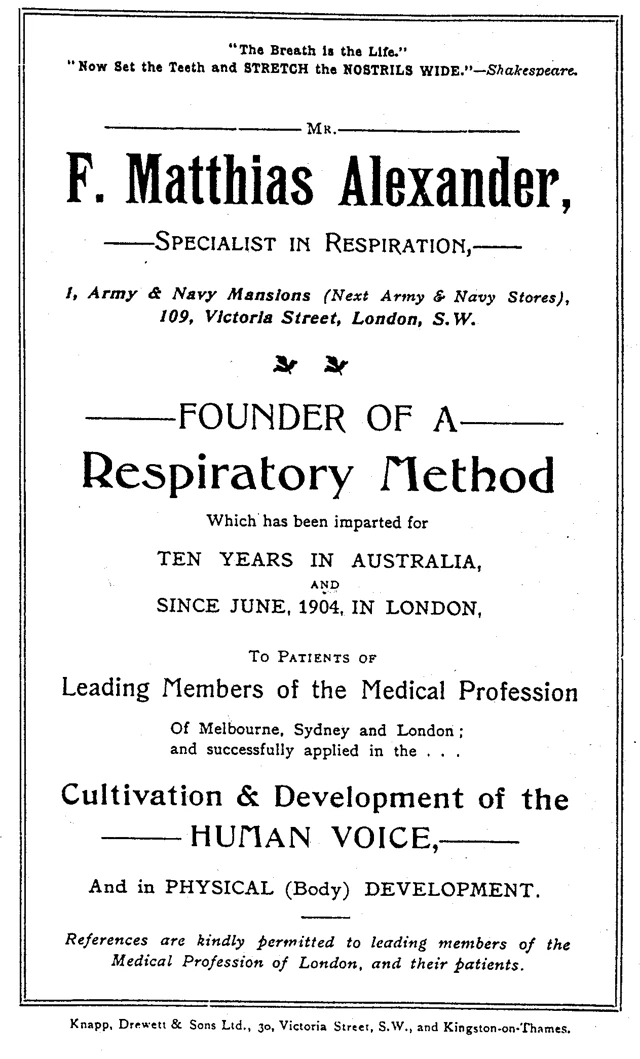
Alexander’s early London publicity. This public-domain poster documents the period when he began teaching in England.
Poster source & credit ↗View an authentic photograph of F. M. Alexander in the National Library of Australia collection ↗F. M. Alexander: an actor learns to observe himself
Frederick Matthias Alexander was born in Tasmania in 1869. His early interests included horses, music and the theater, with Shakespeare becoming an enduring enthusiasm. He eventually pursued a career as an actor and reciter, performing at a time when the quality and projection of a voice were central to reaching an audience.
In Body Learning, Michael J. Gelb recounts a difficulty that became central to Alexander’s account of his discoveries: Alexander became hoarse during performances. Rest could improve the immediate situation, but returning to recitation brought the difficulty back. He began to wonder whether something in his own approach to performing contributed to it.
He used mirrors to compare ordinary speaking with recitation. In his account, he noticed a linked pattern: tightening around his neck, drawing his head back and changing how he took in breath. The pattern became more pronounced when the material was demanding. What had seemed like a problem isolated to his voice led him to investigate a larger pattern of preparation.
His next discovery was less comfortable. When he tried to change the pattern, what he believed he was doing did not always match what the mirrors showed. The intention to move differently could be followed by the familiar response. His sense of correctness had become entangled with habit.
Alexander’s discoveries developed over years, and his descriptions reflect his own interpretation of that process. They are a historical account, rather than evidence that every voice or health problem has the same cause. Their continuing practical interest lies in a more modest observation: intending to change something does not automatically reveal how we are doing it.
Alexander moved to England in 1904 and later began training teachers in 1931. He continued developing and teaching the work until his death in 1955. The profession that grew from it now teaches those principles through lessons adapted to the activities and questions of individual students.
Why a familiar habit can be difficult to recognize
You probably know the experience of hearing a recording of your own voice. Something you produce every day can sound unfamiliar when it arrives through a different route. The surprise does not mean you have been deliberately misleading yourself. It shows how experience can depend on the information available to you.
Alexander encountered a related difficulty in movement: what felt familiar did not reliably tell him whether he was following his intention. He could try to lengthen and instead return to a pattern of shortening. A deeply practiced response could persist beneath a sincere effort to change it.
For a contemporary student, this offers a reason to value observation without becoming suspicious of every sensation. Your experience remains useful. A teacher adds another perspective, helping you compare what you intend, what you notice and what occurs during an activity. The learning happens in the relationship among those observations.
Lara’s approach emphasizes nonjudgmental awareness. Discovering that you lift your shoulders before speaking is information, not a character assessment. You can become interested in when the response appears, what seems to trigger it and whether it changes with guidance. That curiosity provides a more workable starting point than repeatedly telling yourself to stop doing it.
The pause that makes another response possible
Two Alexander Technique terms can sound more complicated than the experiences they describe: inhibition and direction. Understanding them makes it easier to see how a lesson can connect an ordinary movement with a broader process of learning.
Inhibition: allowing a moment before the usual reaction
In this setting, inhibition means pausing before automatically carrying out a familiar response. You receive the intention to act and leave a little room to notice what follows. The skill is relevant to movement, but the basic experience is recognizable in daily life: you can decide to wait before answering a message or interrupting someone.
Alexander’s experiments led him to study this moment before speaking. As his account explains, trying to add a new movement while rushing toward the familiar goal kept reviving the old pattern. He began to investigate whether he could refrain from the immediate response and remain open to another action.
Direction: approaching the action with an intention
Direction concerns the intention you bring to coordinating yourself. In a lesson, your teacher helps make that idea practical through words, observation and gentle contact. You explore a way of approaching movement while noticing the temptation to force a result or reproduce a remembered sensation.
Descriptions sometimes mention allowing the head to move forward and up in relation to the neck and back. Such language needs context and individual guidance. Treating it as a command to push or pull your head into position can turn an educational idea into another muscular task.
Lara introduces these principles through activity. A conversation, a chair movement or a moment of standing can reveal the difference between having an intention and working hard to manufacture its appearance. The aim is to develop an understandable choice you can recognize, rather than memorize terminology.
Head, neck and back: exploring coordination
Alexander’s attention eventually moved beyond his voice to the relationship among his head, neck and torso. He used the term primary control for that relationship. Within the technique, it provides a focus for exploring overall coordination as someone prepares for and carries out an activity.
A student does not need to begin with a detailed anatomical theory. A teacher may ask you to notice how you prepare to stand, then offer guidance while you explore the movement again. Your head, neck and back become part of an observable process, connected with the rest of the action.
This perspective also changes the discussion of posture. A photograph captures one instant, while daily life involves movement, balance and adjustment. An upright appearance can be accompanied by considerable effort. A useful lesson therefore asks how you organize yourself as the activity unfolds, with attention to the possibility of unnecessary holding.
For Lara, this movement education also belongs within a larger conversation about performance. The person approaching a difficult decision is the same person preparing to speak, breathe and move. Observing the whole situation can reveal habits that a purely verbal discussion might leave unexplored.

How the Alexander Technique relates to everyday life
The most useful examples are often undramatic. You do not need a stage or a competition to encounter a habitual response. The following situations illustrate questions a student could bring to a teacher; they are examples of exploration, rather than reports of client results.
At a desk
You begin typing and gradually move closer to the screen. As concentration increases, you may stop noticing how much effort accompanies the task. A lesson could explore sitting, reaching and attending to information, including what happens before your hands meet the keyboard. Your workstation remains relevant, while your own way of using it becomes part of the inquiry.
Before a conversation
You know what you want to say but start rehearsing a long defense before the other person has responded. You might also notice a lifted chest, a held breath or a tightening jaw. Coaching with an Alexander Technique foundation can explore the relationship between those preparations and the conversation you intend to have.
Getting up from a chair
A familiar chair movement offers a repeated, manageable activity. A teacher can observe how you prepare, guide the action and invite you to notice what changes. There is room to examine the movement without needing a complicated performance or special equipment.
Returning home after a demanding day
Finishing a task does not necessarily mean you notice that you have finished. You may bring the same urgency into the next room, the next conversation or the first moments of rest. Lara describes difficulty leaving performance mode as a common reason people approach her directly. The work explores those responses through attention and practical experience, without promising an instant switch.
When trying harder becomes part of the pattern
There is nothing unusual about using effort to learn. A new language, a business responsibility or a musical passage asks something of you. The Alexander Technique introduces a more specific question: is all the effort accompanying this task useful to the task itself?
In the historical account, Alexander found that focusing strongly on getting a sentence spoken could bring back the response he meant to change. He began distinguishing the desired outcome from the way he approached it. The traditional phrase means-whereby points toward attention to that process.
Imagine reading aloud while trying to make every word sound confident. You may become more occupied with producing an impression than with communicating the thought. A teacher could help you study how that intention affects your preparation. The investigation gives the process attention while leaving the goal in view.
Lara describes her work as subtractive. It asks what unnecessary effort can be recognized and left aside. This is especially relevant when someone turns personal development into another demanding assignment. Awareness can begin in an ordinary action, without adding a new standard of flawless self-control.
That distinction matters for ambitious people. The subject of the lesson is how you pursue what matters, including habits that may have become costly or inflexible. Examining those habits can coexist with taking your goals seriously.
Keeping your attention connected with the world
There is a practical reason to resist making awareness a private inspection of every muscle. Most activities involve something beyond you: a person to hear, a thought to communicate, a place to reach or a task to complete. Learning can include noticing your surroundings as well as your preparation.
At a desk, that might mean recognizing the screen, the room and the work in front of you without trying to hold yourself in a carefully arranged shape. In conversation, it might mean returning attention to the person speaking after you have noticed yourself preparing a reply.
These examples offer questions for exploration with a teacher. They leave room for attention to move and for understanding to develop gradually. The value of a skill appears in its relationship with your life: the ability to engage with an ordinary moment while recognizing that your familiar response may be one option among several.
How does this relate to mindfulness, exercise and relaxation?
It is natural to compare an unfamiliar practice with something you already know. Alexander Technique lessons can involve attention, movement and moments of quiet, so they may remind you of mindfulness, exercise or relaxation. Understanding the question a lesson asks helps clarify its particular focus.
An exercise program may develop a chosen ability through repeated activity. An Alexander lesson can examine how you approach an activity, including the preparation that accompanies it. You might study a movement you already perform many times a day and learn something about your response before it begins.
Mindfulness and Alexander work can both invite observation. In this practice, observation is developed through specific activities and feedback from a teacher. The relationship between your intention and your coordination becomes something you can investigate directly.
Relaxation can be a welcome experience, but trying very hard to feel relaxed creates its own puzzle. Lara’s approach gives attention to unnecessary effort without requiring you to produce a particular state on demand. The learning remains connected with something you do, rather than an ideal feeling you must maintain.

What happens in an Alexander Technique lesson?
A private lesson usually begins with your experience: what interests you, what activities you want to explore and what questions you have. You might bring a general curiosity about movement or a very specific moment that keeps recurring. Your teacher uses that information to give the session a practical focus.
You remain fully clothed in comfortable everyday clothing. The work may involve sitting, standing, walking or another simple activity. Gentle hands-on contact and verbal instruction help you notice coordination and familiar responses. Ask questions about the guidance and describe what you notice; active participation is central to learning.
Some lessons include table work, providing another context for observation. The important point is the educational process, rather than the furniture or the impression that you should have a particular feeling. A useful experience becomes more valuable when you begin understanding how it relates to what you do.
A first appointment also gives you a chance to learn the teacher’s language and pace. The technique may feel unfamiliar because it draws attention to preparation you normally pass over. You do not need to demonstrate an ideal posture or arrive already able to identify your habits.
At Elemntal Wellness, Lara specifies a 90-minute introductory session and 60-minute follow-ups. These are her appointment formats, not a universal duration for Alexander Technique lessons. Her service page explains how to discuss individual lessons and view the packages currently available through online booking.
Alexander Technique benefits: what can you work toward?
People arrive with different hopes, so useful goals should be described in terms that can be explored. You might want greater awareness during movement, a clearer understanding of habitual effort or a more deliberate response before speaking. Another student may be interested in balance, breathing during activity or physical presence.
Early progress can be quite specific. You recognize the beginning of a familiar response. You can describe what happens before you move. You discover that an activity offers more than one possible approach. These observations may sound small, but they give the next lesson something concrete to develop.
With continued learning, the aim includes greater independence. A teacher’s reminder can eventually become a question you know how to ask yourself. The work becomes relevant outside the lesson when you recognize a familiar situation and have an opportunity to respond with more awareness.
Experiences vary, and a historical account of Alexander’s own difficulties does not establish a result for someone else. Lara’s lessons are offered as education, not diagnosis, medical treatment, massage or psychotherapy. A movement lesson does not replace appropriate care for a health concern.
The most useful conversation about benefits therefore connects an aspiration with your actual life. If you want more presence, which conversation matters? If you want to notice tension, during what activity? Those questions turn a general promise into a learning goal you and your teacher can examine.
Learning over time, without constant self-monitoring
Recognizing a habit once and changing your relationship with it are different stages of learning. A response may be easy to notice in a quiet lesson and difficult to recognize when you are busy, distracted or eager to finish. Repetition gives you opportunities to return to the same question under different conditions.
A series also allows the teacher to revisit guidance as your understanding develops. An instruction that initially sounds abstract may become clearer after several experiences. An observation from work or home may reveal a question you could not have anticipated at the first appointment.
Practicing between lessons can begin with bringing those observations back. You might notice how you prepare to answer a call or what happens when you reach for a familiar object. Discuss with your teacher which activities are useful to explore. There is no need to turn every movement into a test.
Constantly checking yourself can become another form of effort. Lara’s nonjudgmental approach offers a useful counterweight: notice, become curious and allow the learning to develop. The purpose is a growing ability to make choices in life, including moments when you would rather give your attention to the person or activity in front of you.
Useful questions to bring to your first lesson
A good starting question is personal enough to matter and ordinary enough to explore. You could ask what happens when you prepare to speak, why you seem to hurry through a familiar movement or how you approach a task when you expect it to be difficult. Curiosity gives the teacher something useful to work with.
You can also ask how the lesson will proceed. What kinds of activities might be included? How does the teacher explain hands-on guidance? How can you describe an experience that is difficult to put into words? Clear communication helps you take an active role in the educational process.
Another useful question concerns the relationship between an immediate experience and continued learning. Something may feel different during a lesson. Ask what you can understand from it, what deserves further exploration and how it might relate to the activity you brought. A striking sensation is only one possible part of the experience.
You do not have to arrive with a polished explanation or the right vocabulary. A simple description of an everyday situation is enough to begin a conversation.
What if the familiar pattern returns?
It probably will appear again at some point. A habit becomes familiar through repetition, and recognizing it during one lesson does not make it disappear from every situation. Its return can offer useful information about the conditions in which it shows up.
Perhaps you notice a response easily when you have time, but miss it when someone is waiting for an answer. Perhaps an activity feels straightforward until you become concerned about doing it correctly. These differences help make the inquiry more specific.
Alexander’s own account describes repeated encounters with this difficulty. His intention could be clear, yet the moment of acting brought the familiar response back. That is why his investigation increasingly concerned the preparation for action and his willingness to reconsider what he was about to do.
Lara’s emphasis on nonjudgmental observation gives those recurring moments a constructive role. You can bring them into the next session and examine them with guidance. Learning becomes a continuing conversation with your experience, with room for uncertainty, questions and discoveries.
Finding an Alexander Technique teacher near you
If reading has made you curious, look for a teacher whose training and explanation of the work you can understand. Ask about their qualifications, the lesson format and the activities they commonly explore. A useful conversation should help you decide whether the approach fits your interests.
Books and videos can introduce ideas, vocabulary and history. Working with a teacher adds observation and feedback related to your own activity. This matters because the gap between intention and habit can be difficult to recognize from your perspective alone.
For readers searching for Alexander Technique lessons in Salt Lake City, Lara’s service pages provide a starting point. Review her background, consider the questions you would like to bring and discuss the available formats directly with her. The aim is an informed choice about an educational experience that you will actively help shape.

High Performance Coach & Certified Alexander Technique Teacher (AmSAT)
Explore Lara’s background ↗Exploring Alexander Technique with Lara Wilde in Salt Lake City
Lara Wilde is a high-performance coach, founder of Wilde Alliance and an AmSAT-certified Alexander Technique teacher. Her background includes more than 2,000 hours of teacher training, developmental movement training with Luc Vanier and work as an assistant on the Salt Lake City Alexander Technique AmSAT teacher training course.
Her background as a former collegiate high jumper and entrepreneur informs her interest in people pursuing demanding goals. Her clients can include leaders, founders, athletes, musicians, performers, partners and people navigating change. You can also approach a private lesson with a straightforward interest in everyday movement.
The technique has two places in her services. Private Alexander Technique lessons offer a standalone educational pathway. In leadership and high-performance coaching, the same principles help connect mindset and professional goals with the responses that appear during real activity.
Lara’s approach begins with observation, explores a pause before an automatic reaction and develops a more intentional way forward. You might study a chair movement, discuss a recurring challenge or explore speaking under imagined pressure. The specific activity follows the focus of the work.
Sessions begin in person at Elemntal Wellness, 360 W Broadway, Suite 102, in downtown Salt Lake City. Lara recommends a 12-session series, generally meeting at least weekly, with more frequent work and a 30-day immersion available to discuss. Remote follow-up is offered after completing an initial in-person package or 30-day intensive.
To understand the options, start with the Life Coaching overview and About Lara Wilde section. You can then explore the individual service pages and contact Lara about the format that suits your interests. Current bookable packages and pricing appear in Boulevard; individual session arrangements can be discussed with her directly.
A practical place to begin
You do not need to decide that every part of your life requires changing. Start with a moment that interests you: the preparation before a sentence, the way you settle at your desk or the effort involved in an ordinary movement. Bring the question to someone who can help you explore it. A thoughtful first question is enough to begin.
Alexander’s story remains compelling because it begins with observation. He wanted to do something important to him and discovered that his familiar way of approaching it deserved attention. The gap between intention and habit became a place to learn.
For a modern reader, the invitation is similarly practical. Become curious about what happens as you act. Allow room for another response. Learn with guidance, and connect the experience with the activities that make up your day.
If that inquiry interests you, explore Lara Wilde’s Alexander Technique services at Elemntal Wellness. Her work offers a local starting point for learning about movement, awareness and the possibility of approaching everyday life with less unnecessary effort.
Sources & further reading
Historical background was informed by the supplied excerpt from Michael J. Gelb’s Body Learning, “F. M. Alexander: The man and his discovery.” Lara’s service descriptions and training details come from her Wilde Alliance questionnaire supplied for Elemntal Wellness. This article uses original prose; the everyday scenarios are illustrative.
- American Society for the Alexander Technique: What is the Alexander Technique?
- AmSAT: Alexander Technique concepts and lessons
- The F. Matthias Alexander Trust: Alexander’s life and teaching
- National Library of Australia: authentic archival photograph of F. M. Alexander
Historical poster: unknown creator, commissioned for F. Matthias Alexander; Wikimedia Commons, public domain. Contemporary editorial images are generated illustrations of the subject, rather than photographs of Lara, her clients or the actual studio. Lara’s portrait is her supplied photograph.